FAQs

We accept applications year-round, subject to space availability. This may vary during annual school breaks.

You can expect to receive a decision within 2 weeks after completing all required steps in the admissions process.

Yes. Partial-year enrollment is possible, subject to space availability, with a minimum commitment of three months.

-Tuition: $1,250 per month, per child
-Matriculation and Materials Fee: paid in full, regardless of the enrollment period

All students must complete the admissions process, including submission of required documents, a parent interview, and a five-day trial period before enrollment can be confirmed.

While English proficiency is beneficial and recommended, it is not a requirement for admission.

Gaia School is committed to inclusive education. If your child has a physical, cognitive, or social condition, we ask families to provide documentation from a relevant professional outlining the condition and any specific needs.

We work closely with families to understand each student’s needs and assess whether our available resources can support them appropriately. While we would like to welcome all children, our ability to do so depends on the level of support we are able to provide.
For further questions or to discuss your child’s needs, please contact our admissions team at admissions@gaiaschoolcr.org.

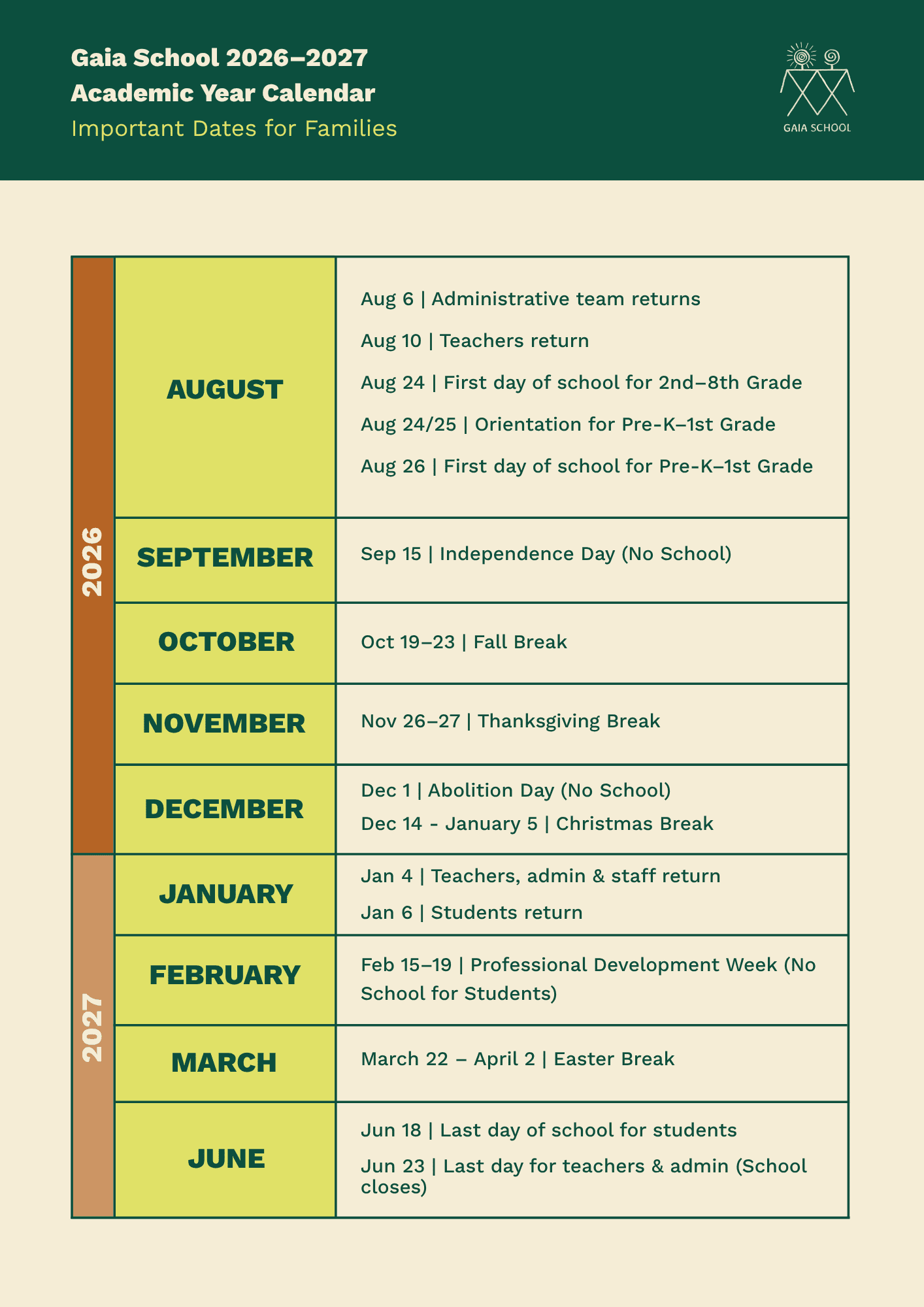
Gaia School follows an international academic calendar, with the school year running from late August through mid-June. For key dates, holidays, and school events, please refer to our School Calendar:

Yes. We offer transportation routes covering San Isidro, Mal País, Santa Teresa, Hermosa, Santiago, and Manzanillo.

For more details on availability, schedules, and pricing, please contact Ivannia Fernández at ivannia.fernandez@gaiaschoolcr.org.

We are pleased to offer a gluten-free, sugar-free, and plant-based menu. Our meals are made with fresh, whole, organic ingredients and are carefully designed to meet the nutritional needs of growing children.

The food program fee is included in the monthly tuition.

-Pre-K: maximum of 12 students per class
-All other grades: maximum of 18 students per class

“The need for imagination, a sense of truth, and a feeling of responsibility – these three forces are the very nerve of Education.” – Rudolf Steiner

Waldorf education emphasizes developmentally appropriate learning that integrates nature, science, art, music, movement, and interpersonal development. In the early years, learning is highly experiential, and children may spend much of their day outdoors.

Waldorf education is academically rigorous. Although some subjects, such as formal reading, begin later than in conventional schools, students often develop strong academic, artistic, and social capacities in a well-balanced way.

For older students, advanced subjects are often taught through project-based learning, connecting academic content with real-world application.

Both Waldorf and Montessori are alternative approaches to education, but they differ in important ways.

Waldorf education integrates academics with creativity, imagination, and a strong sense of community. It follows a gentle, teacher-guided approach in which learning unfolds in an age-appropriate and balanced way..

Montessori places more emphasis on self-directed exploration, while Waldorf creates a warm, artistic, and home-like environment where storytelling, movement, and creative expression are central to the learning process.

Formal reading instruction typically begins around ages 6 to 7, usually in first grade.

In the early years, Waldorf education focuses on movement, play, oral language, storytelling, and sensory experiences. These elements support neurological development and build the foundation for strong literacy skills.

This approach reflects the understanding that reading readiness emerges from a well-integrated developmental process, rather than being introduced prematurely.

No. Waldorf schools are non-sectarian and non-denominational, and they welcome children from all cultural and religious backgrounds.

While Waldorf education recognizes a spiritual dimension to human life, it is not affiliated with any church or religious doctrine. The curriculum includes mythology, festivals, and cultural studies from different traditions, encouraging students to develop a broad and inclusive worldview.

Our teaching team is diverse and international, with educators from different countries, many of whom have strong roots in Costa Rica.

All of our teachers hold university degrees. Some come with Waldorf certification, while others are experienced educators who receive ongoing Waldorf mentorship and training.

Each year, teachers participate in continuous professional development, including:

-Annual Waldorf teacher training, both locally and internationally

-A dedicated professional development week every February at Gaia School, led by experienced Waldorf educators

Yes. Gaia School is actively developing a bilingual program that integrates Spanish and English instruction from the earliest grades to support a diverse and inclusive learning environment.

At present, Gaia accepts students from Pre-K through 6th grade and plans to add one grade per year until reaching 12th grade.

Yes. Colleges and universities around the world recognize and accept Waldorf high school graduates.
The holistic nature of Waldorf education prepares students with strong academic, creative, and critical thinking skills that support success in higher education.

Gaia plans to pursue both Costa Rican accreditation through MEP and international certifications such as Waldorf and SACS, among others.
These processes typically take several years. If specific accreditations are important to your family, please contact the Head of School at brayan.munoz@gaiaschoolcr.org

Gaia School is a non-profit institution committed to offering high-quality education at cost.
To support long-term sustainability, the school anticipates annual tuition adjustments in line with inflation, typically between 5% and 10% per year.

Gaia continues to develop its educational program in response to campus growth, community interest, and the school’s ability to integrate qualified teachers and staff. To learn more about our development, recent milestones, and projections, we invite you to review our Annual Report

Gaia School was established as a non-profit association. All tuition and donations are reinvested into the school.
In the early years, the costs of land, facilities, and operations are supported by donations. Over time, the goal is for tuition to cover annual operating costs and scholarship programs.

Yes. The safety and security of students, staff, and visitors are a top priority at Gaia School.
The campus includes 24-hour security provided by an external company registered with Costa Rica’s Ministry of National Security. Gaia continuously evaluates and improves its safety protocols to maintain a secure learning environment.